






Beijing, December 15 (Xinhuanet) — The 16th Xinhuanet Education Forum, themed "Harnessing the Wisdom of the Times, Leading Educational Innovation," was held in Beijing on December 11. During the second phase of the Basic Education Sub-Forum in the afternoon, Li Tong, Head of the Xueersi Learning and Practice Tablet System, participated in a panel discussion with other guests centered on the theme "Empowering and Reshaping: Finding the Anchors for Education in the Era of Artificial Intelligence." Li shared insights and practical examples on AI-powered education.
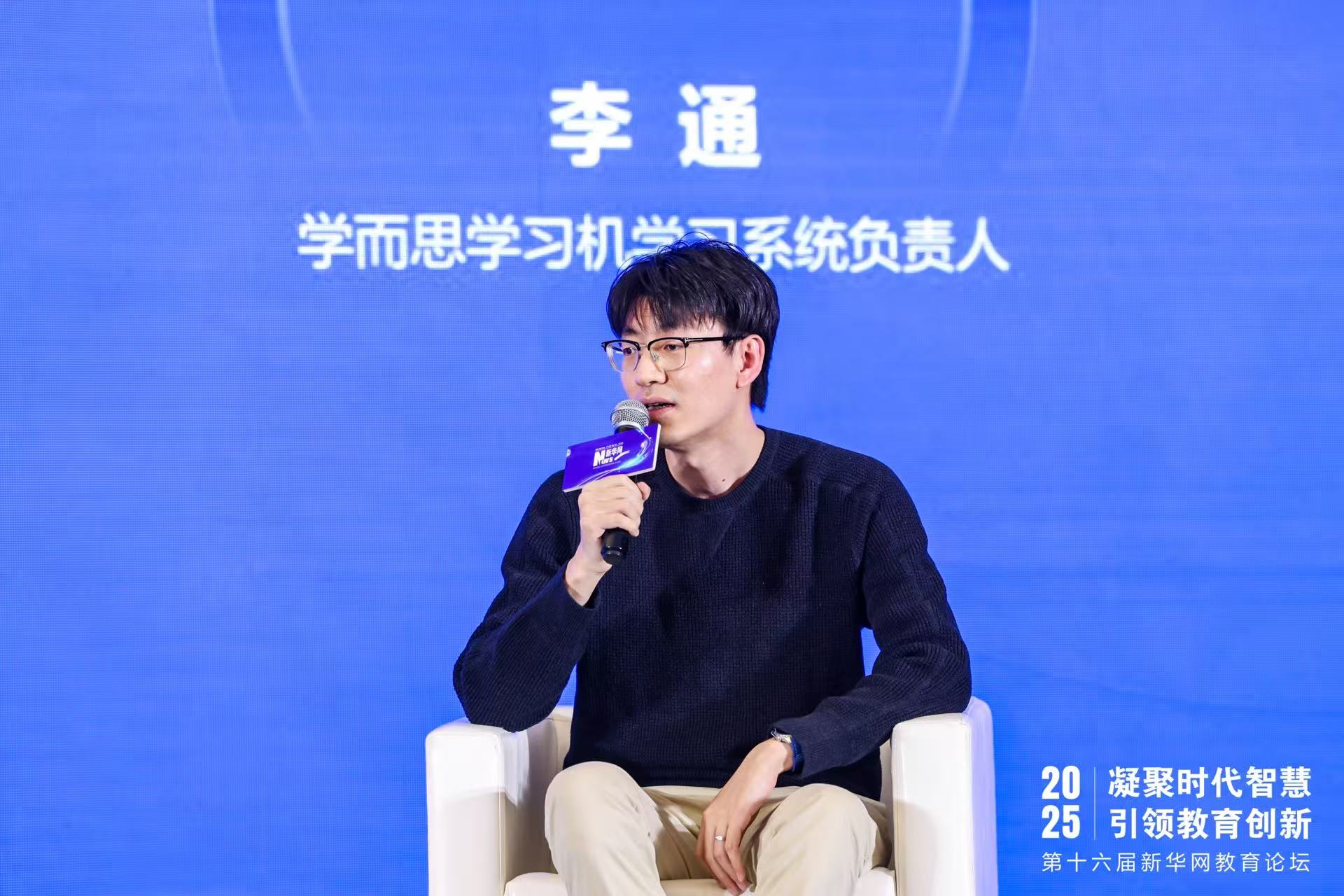
Li Tong stated that 2025 might mark the real beginning of AI's deployment in the education landscape. Since the rise of large language models in November 2022, the industry has shifted from high expectations to a more rational perspective. As these technologies continue to be refined in real-world applications, their developmental trajectories are becoming increasingly clear. This year, two significant technological breakthroughs have laid a solid foundation for the deeper integration of AI into education. The first is the reasoning-based large model launched by DeepSeek, which has demonstrated high accuracy in solving pure-text math problems, providing reliable technological support for intelligent grading and explanations. The second is Google's large image model, which has achieved a high level of performance in generating PowerPoint presentations and synthesizing presentation videos, further expanding AI's capacity for creating educational materials. Li emphasized that these advancements in foundational models have significantly improved AI's performance in educational reasoning and generation tasks, pushing the industry into a new phase of practical application.
When discussing the core challenges of creating AI that truly understands education and can accompany learners, Li stressed that a deep understanding of the principles of education is far more important than mastering the technology itself. He highlighted that all technological development and tool innovation must focus on the essence of education. In actual product implementation, the role of research teachers should precede that of product managers, making them the key to defining product functionalities. Li noted a gap between current large models and the actual teaching needs of educators, with a critical breakthrough lying in how teaching principles can be effectively translated into data for injection into AI models. Educational knowledge includes both explicit and tacit components, and senior teachers' experience often cannot be easily structured into data, presenting a major challenge for AI in emulating the wisdom of teaching.
Additionally, business systems within enterprises and educational institutions are often siloed, and there are barriers between operational processes and datasets. Systematically integrating high-quality data accumulated by teachers during teaching practices and using it to train AI models more aligned with real teaching needs is a key step toward realizing the concept of an "AI teacher."
Regarding the design of educational scenarios and the preservation and cultivation of "core human qualities" that AI cannot replace, Li emphasized that the essence of education lies in the companionship and mutual influence between people. Currently, Xueersi is working on an "AI teacher" product, but the technology today is still unable to fully replicate it. A teacher's core value lies not only in their knowledge but also in their unique personal experiences and characteristics. These constitute the spiritual and experiential differences between individuals, which cannot be simulated by data-driven large models. Li expressed hope that AI can help free teachers from burdensome tasks like attendance, grading, and lesson preparation, allowing them to devote more energy to creative teaching endeavors.
Finally, Li shared his vision for AI's development in the education sector over the next five years. He believes that lifelong learning will grow rapidly. Today's large models provide everyone with a "knowledge plug-in," enabling people to access knowledge more quickly and efficiently. From this perspective, AI offers great convenience for lifelong learning and points the way toward unlocking future opportunities.



 2131
2131